Anchoring bias
The first number you see disproportionately shapes every judgment that follows.

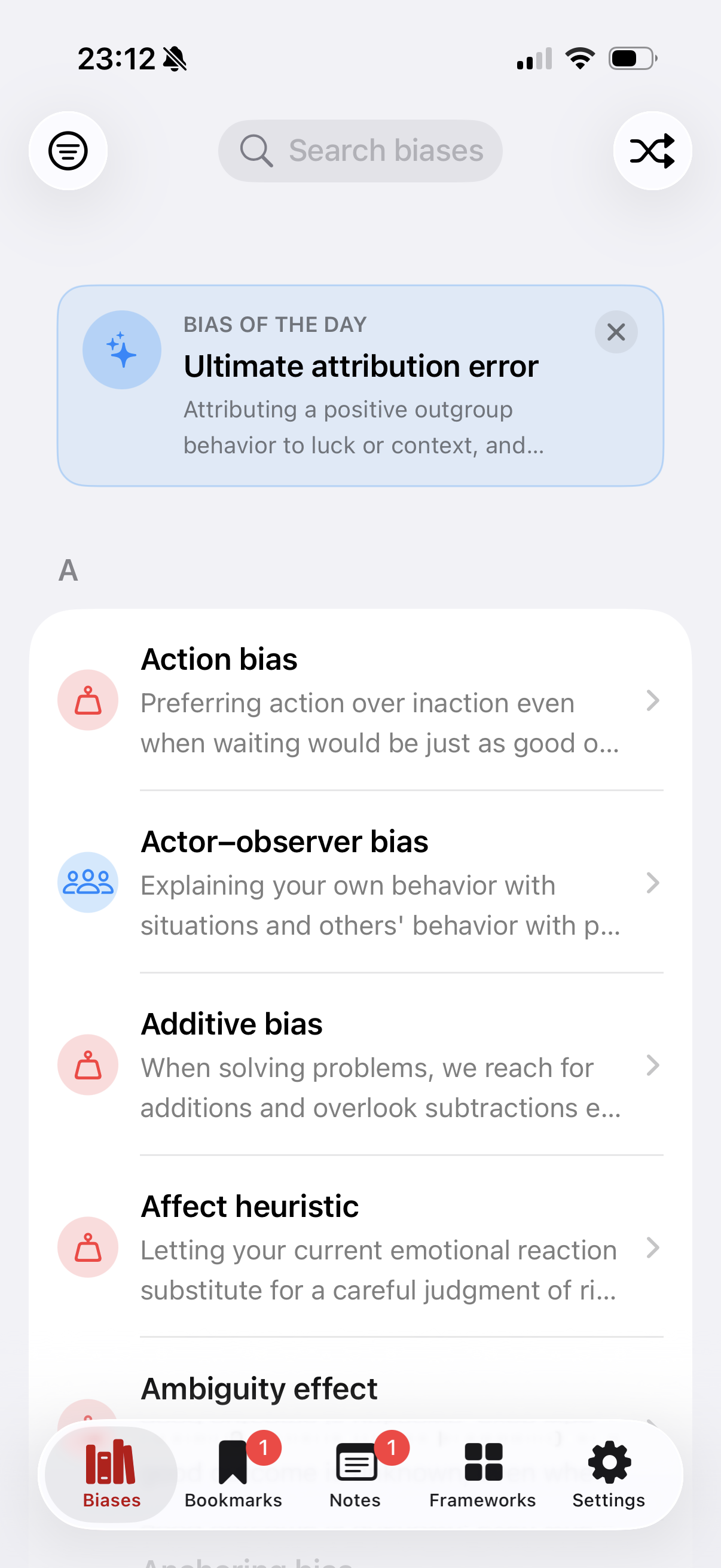
A beautifully illustrated field guide to 194 cognitive and behavioral biases, each with a one-glance diagram, the classic studies, and the frameworks behind it. Built by the Center for Behavioral Decisions.
Not a wall of definitions, a designed, cross-linked, citation-backed handbook that makes each bias click.
Most entries open with a hand-drawn schematic, an anchor dragging an estimate, a filter blocking evidence, a tipped scale. The idea lands before you read a word.
Cross-links jump you between related biases in a tap; references open the Wikipedia article or the original paper in Safari.
Every bias carries a short “In the literature” note, the theoretical lineage, the key reviews, the live debates, distilled from primary sources.
Real experiments on every page: Tversky & Kahneman’s rigged wheel of fortune, Loftus on false memories, Pronin on the bias blind spot.
Find any of the 194 biases instantly, narrow by category, or tap shuffle when you want to be surprised by one.
Save the biases you return to and write your own examples, kept entirely on your device, synced nowhere.
Anchoring · framing · sunk cost · loss aversion
Confirmation bias · availability · gambler’s fallacy
Halo effect · in-group bias · attribution error
Hindsight bias · misinformation effect · peak–end
Dunning–Kruger · overconfidence · self-serving bias
The full catalog, on the App Store.
The first number you see disproportionately shapes every judgment that follows.
We search for, read, and remember information in ways that confirm what we already believe.
We keep investing because of what we’ve already spent, not what we’ll actually get back.
The less skill we have in a domain, the more we tend to overestimate it.
Losses hurt about twice as much as equivalent gains feel good.
If examples come to mind easily, we assume they’re far more common than they are.
The models practitioners actually use to change behavior, each one diagrammed and explained, so a bias becomes something you can act on.
Bias Handbook is a fully offline reference. The entire catalog ships inside the app and is read from your device, so there’s nothing to leak.
Designed and produced by the Center for Behavioral Decisions; published on the App Store by StepApp, Inc. Sourced from Wikipedia’s List of cognitive biases and the underlying primary literature, Tversky & Kahneman, Slovic, Loftus, Gilovich, Pronin, Loewenstein, Roediger, Carstensen, Pettigrew, and others.
Get the app
194 biases, 12 frameworks, and the science behind them, offline and always in your pocket.
iOS 17+ · No ads, no tracking