The True Direction and Meaning of Learning in Organizations
Better training does not guarantee meaningful change when workplace systems reward the very behaviors a program aims to replace. This article explores why effective organizational learning begins with diagnosing the real problem, creating conditions for applying what is learned, and aligning evaluation, recognition, and everyday decisions with the intended change.
1. Introduction
In 2020, the global corporate training market was estimated at around 370 billion dollars (Statista, 2021). That figure has grown steadily over the last three decades without a proportional improvement in organizations' capacity to learn and adapt. Brinkerhoff (2006) documented that the application of learning on the job depends on multiple factors and tends to be limited in corporate contexts. Georgenson (1982) estimated that only around 10% of training content translates into behavioral change at work, a figure the author himself acknowledged as an approximation, but one that points to a gap between investment and effect that has persisted for decades.
When results fail to materialize, the usual response is to revise the methodology, update the content, or change the format. That logic locates the problem in how things are taught. Baldwin and Ford (1988), in a seminal review of the field, showed that the application of training depends on three groups of factors: learner characteristics, training design, and the work environment. Within the environment, supervisor support and the opportunity to practice what has been learned are the strongest determinants, more so than any methodological decision made in the classroom.
This article examines what conditions allow organizational learning to produce real effects. Three simultaneous dimensions shape that answer: the nature of the problem the organization faces, the characteristics of the context where learning must be applied, and the alignment between what the organization declares and what its systems actually reward. All three can be assessed before designing any initiative, and that prior assessment defines what kind of action makes sense and which is destined to produce nothing.
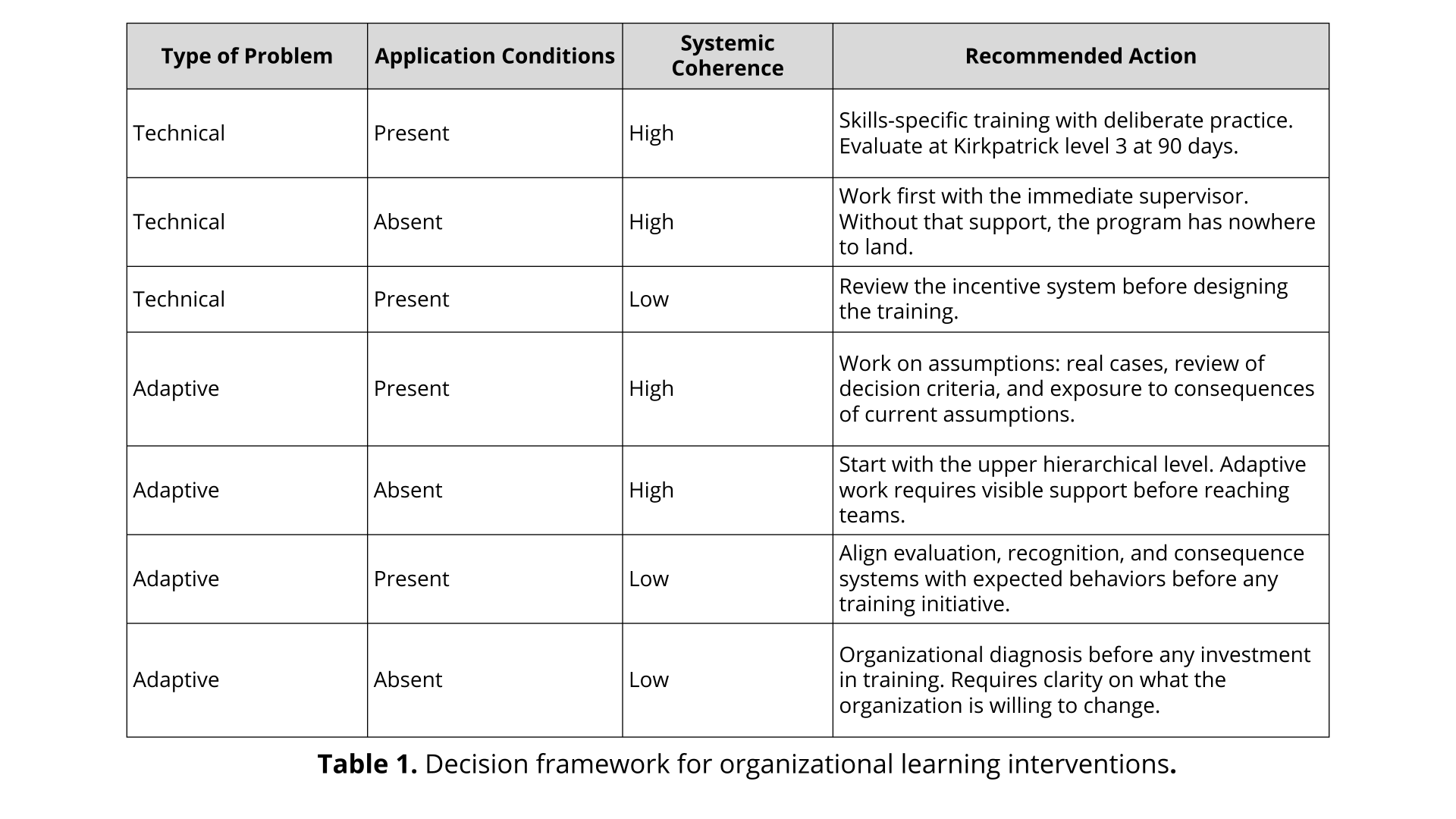
The article is organized as follows. Section 2 examines the application problem as the starting point of the analysis. Section 3 introduces the distinction between technical and adaptive problems as a prior diagnostic criterion. Section 4 analyzes the role of culture as the context that determines whether learning is used. Section 5 examines the positioning of Learning and Development when diagnosis precedes design. Section 6 describes the structural tensions that condition everything above. Section 7 presents a consulting case from Chile that illustrates how the framework translates into concrete decisions. Section 8 synthesizes an applied framework of three diagnostic dimensions with a decision table.
2. When Learning Stays in the Room
Kirkpatrick (1994) proposed a four-level model for evaluating the impact of training: reaction, learning, behavior, and results. Organizations measure the first level regularly because it is easy to capture at the end of a session. The fourth almost never, because it requires sustained follow-up and accepting that the answer may contradict the investment made. That asymmetry produces a recurring illusion: programs appear successful because participants leave satisfied, even though nothing has changed in how they work.
Saks and Belcourt (2006), in a sample of 150 Canadian organizations, found that training managers estimated that 62% of employees applied what they had learned immediately after training; that percentage fell to 44% at six months and to 34% at one year. Most of the loss occurred in the first weeks for identifiable reasons: lack of supervisor reinforcement, lack of opportunity to practice, and contexts that rewarded prior behaviors.
Baldwin and Ford (1988) systematized those factors into a model that remains a reference in the field. They identified three categories of variables that determine application: learner characteristics, training design, and work environment, understood as supervisor support and the opportunity to use what was learned in real work. Subsequent research consistently identified the work environment as the factor with the greatest weight, above program content and methodology.
A pattern of recurring planning delays is not solved with a time management workshop. It requires reviewing how tasks are prioritized, how responsibilities are distributed, and how decisions are made in the face of the unexpected. When that review does not happen, people learn something in the room and return to a setting that has not changed. Three years of workshops, readings, and coaching sessions can coexist with stagnant climate indicators and high turnover without anyone asking whether the problem is one of skills or something else.
3. When the Problem Is Not About Skills
Heifetz (1994) distinguished two types of problems. Technical problems have known solutions and are resolved by applying existing expertise: a team that does not know how to use a new tool, a process that needs documentation, a skill that can be taught and practiced. Adaptive problems have no expert solution available: they require people to modify their values, beliefs, or ways of working, as happens when an organization needs to collaborate across departments that have historically competed, or when leadership must relinquish control in an environment that has always rewarded it. Confusing the two types is, according to Heifetz, one of the main causes of failure in change processes.
Kegan and Lahey (2009) developed that distinction with a framework they called immunity to change. They observed that people who genuinely want to change, who have declared intention and rational understanding of the change needed, often fail to achieve it. The cause is the competing commitments that protect deeper assumptions about how the world works and how they must behave in it. A leader who declares wanting to give more autonomy to their team while simultaneously reviewing every decision is not a hypocrite: they have a hidden commitment to control that protects a deeply held assumption about what happens when things go wrong. Addressing that problem with a participatory leadership program produces frustration in both directions.
Argyris (1991) described that mechanism from another perspective. The most competent professionals, those who have invested the most in their own development, are frequently the most resistant to double-loop learning, the kind that requires questioning the assumptions that govern action. Their professional identity is built on certain ways of operating, and questioning them is experienced as a threat to that identity. Without intervening at the level of assumptions, any development program may leave intact, or even reinforce, exactly the patterns it seeks to modify.
Faced with a technical problem, training in specific skills may be sufficient. Faced with an adaptive one, learning must work on the criteria that guide decisions, not on the procedures that execute them. Diagnosing the type of problem before designing determines whether the action has real possibilities of producing the expected effect.
4. Culture as a Decision System
Schein (2010) described organizational culture in three levels that operate with different degrees of visibility. The first includes artifacts: what can be seen, heard, and observed directly, from the physical layout of spaces to recognition rituals. The second groups the values and beliefs the organization states publicly. The third are basic assumptions: beliefs that no one explicitly questions and that determine how decisions are made under real pressure.
Argyris and Schön (1974) named that gap with precision. They distinguished between espoused theory, what people say they do, and theory-in-use, what they actually do when facing concrete situations with time pressure, resource competition, or risk to individual performance. No culture campaign touches it. The gap narrows when expected behaviors have real and consistent consequences, and when those consequences are visible to everyone. When that alignment does not exist, culture acts as a filter that transforms declared intentions into different behaviors, and learning that does not account for that filter arrives at a place that neutralizes it before it can produce any effect.
Edmondson (1999) provided empirical evidence on one of the most relevant cultural conditions for learning: psychological safety, defined as the shared belief that the team is a safe place to take interpersonal risks. In a study with hospital teams, she found that teams with higher psychological safety reported more errors, not because they made more but because they named them, and those teams learned faster. Those operating with lower psychological safety concealed errors and kept making them.
Noe (2010) formalized that argument in the concept of transfer climate, defined as the degree to which the work environment supports the use of what was learned. His research showed that this climate predicts the impact of training more strongly than program design: the same content produces different effects in organizations with different climates. Measuring the transfer climate before designing a training initiative is a diagnostic step as relevant as understanding the type of problem being faced.
What happens when a project fails, who participates in decisions that affect others' work, how someone is responded to when they point out something no one had seen: that is where the culture is. Those moments say more than any internal document.
5. Developing Capabilities Before Courses
Ulrich and Brockbank (2005) argued that the value of human resources functions is not measured by the number of services they provide but by their capacity to anticipate what the organization needs to operate and adapt. That distinction defines two ways of functioning for Learning and Development. The first responds to requests: someone identifies a need, requests training, and L&D designs and delivers it. The second works on capabilities: it identifies what the organization needs to know and be able to do to fulfill its strategy, detects the gaps, and acts before they become visible problems.
Boudreau and Ramstad (2007) developed that argument with the concept of talentship: a framework for making decisions about human capital with the same analytical rigor applied to financial decisions. They proposed that human resources and development functions must be able to answer three questions before any investment in training: what impact will it have on the organization's decisions and results, what capabilities are critical to produce that impact, and where is the gap between current and required capabilities.
Garvin, Edmondson, and Gino (2008) identified three building blocks that characterize organizations that learn effectively: a supportive environment, practices that integrate learning into daily work, and leadership that models learning behaviors. L&D can influence all three. In practice, the function tends to arrive after decisions have been made and works on the second building block. The first and third remain outside its reach.
Prioritizing with judgment, rejecting what does not produce effect, and adjusting proposals to the real business context defines the role the function occupies, more than any internal statement of purpose.
6. Deciding Between the Urgent and the Necessary
March (1991) showed that every organization lives in tension between exploiting what it already masters and exploring what it does not yet know. Exploitation produces predictable short-term results. Exploration opens possibilities for adaptation but is costly and uncertain. Organizations under pressure for results tilt toward exploitation, and lose ground in the second direction without registering it as a loss.
Senge (1990) described how organizations become trapped in structures that reinforce their own problems. One of the most common is the shifting of the burden: a short-term solution is applied that relieves the symptom without addressing what produces it. Training people in time management while the organization continues assigning more work than can realistically be handled is a direct example.
O'Reilly and Tushman (2004) developed the concept of organizational ambidexterity: the capacity to manage efficiency and innovation simultaneously. Their research showed that organizations that achieve this capacity do not do so by structurally separating both logics, but by developing leaders capable of shifting modes depending on what the situation requires. An innovation program in an organization that penalizes error arrives at an evaluation system that already has its own logic, and that logic wins.
Crossan, Lane, and White (1999) proposed the 4I model to describe how learning moves through the levels of an organization: intuition at the individual level, interpretation at the group level, integration at the organizational level, and institutionalization in systems and structures. When the process stops before the last level, experience remains with individuals or in conversations without changing anything formal. Processes, evaluation criteria, and established practices remain the same.
The tensions between immediate results and capability development, between standardization and adaptation, between control and experimentation, are present in every decision the L&D function makes, before any program begins.
7. Case Study: When the Problem Was Not Where It Was Thought to Be
What follows occurred between 2021 and 2022 with a financial services company of 200 people, with a presence in Santiago and three regions.
Context
The Human Resources department had been running a leadership development program for three years with consistently high satisfaction ratings, between 4.2 and 4.6 out of 5. The program included quarterly in-person workshops in Santiago, monthly readings, and group coaching sessions. Leaders participated actively and valued the space. Organizational climate indicators were not improving, turnover among the direct teams of participating leaders remained above the sector average, and engagement surveys showed the same scores as the previous year on autonomy and trust in leadership.
The HR management asked me to review the program to identify what methodological adjustments could improve results.
Diagnosis
I began with three questions derived from Heifetz's (1994) framework: was the problem the program was trying to solve technical or adaptive?, did conditions exist for what was learned to be used in real work?, did the organization's systems reinforce the behaviors the program promoted?
The program promoted participatory leadership, delegation, and the development of autonomous teams. When I reviewed the performance evaluation system, the decision-making process, and the promotion criteria, I found that all three consistently rewarded direct execution, individual response speed, and control of team results. Leaders who delegated more took longer to show visible results, and that hurt them in evaluation cycles.
The supervisor support for the behaviors the program promoted was low. The managers of the participating leaders had not been involved in any part of the program, and in several meetings openly questioned the time invested in development activities that, in their view, "took focus away from results." Noe (2010) identified that support as one of the variables that most determines whether what is learned reaches actual work.
When I applied the Argyris and Schön (1974) framework, I also found a gap between espoused theory and theory-in-use within the senior leadership team itself. Messages about autonomy and people development coexisted with a practice of detailed review of every operational decision, centralized approval cycles, and progress meetings where middle leaders presented updates without any real capacity to change course. That gap was visible to everyone. No one named it.
Redesign
The changes were made before touching any training component and on three fronts.
The first was structural: we revised the performance evaluation process to explicitly include indicators of team development and effective delegation behaviors. As long as that system rewarded direct execution, leaders had no practical reason to delegate.
The second front was with the managers of the participating leaders: I designed three sessions to work with them on exactly what the program was asking of their teams. Garvin, Edmondson, and Gino (2008) identified leadership modeling as one of the three building blocks of effective organizational learning. Without that work, the program's messages collided with what managers did every day.
The third was follow-up: we defined three measurable indicators at 90, 180, and 360 days: the frequency of formally documented delegated decisions, climate results in the direct teams of participants, and turnover in those same teams. Crossan, Lane, and White (1999) describe how learning becomes institutionalized when it modifies formal processes and practices. Those three indicators measured exactly that.
Results at 12 Months
At twelve months, climate indicators in the direct teams improved by 0.4 points out of 5 on the autonomy and trust in leadership items, compared to 0.05 points in the previous cycle. Turnover fell from 18% to 12% annually. Leaders documented an average of 2.3 formally delegated decisions per month, compared to 0.4 in the prior period.
8. A Framework for Intervening With Judgment
Three dimensions determine whether a learning initiative produces effect. The first identifies the type of problem. The second evaluates whether the context has conditions for what was learned to be used. The third reviews whether the organization's systems reinforce the behaviors the initiative promotes. A precise diagnosis on the first resolves nothing if the second or third block application.
8.1 Dimension 1: Type of Problem
Identifying whether the problem is technical or adaptive defines the type of response that makes sense. A technical problem has a known solution and is resolved by transferring expertise. An adaptive one requires reviewing assumptions and changing decision criteria; addressing it with skills-based training tends to deepen resistance. The diagnostic questions for this dimension, derived from Heifetz (1994) and Kegan and Lahey (2009), are: does the organization know what to do but not do it?, are there competing commitments that protect the status quo?, does the problem recur even after it appears to have been resolved?
8.2 Dimension 2: Application Conditions
The key variables for this dimension, derived from Baldwin and Ford (1988) and Noe (2010), are: supervisor support for new behaviors, the opportunity to practice what was learned in real work, and the absence of negative consequences for applying it. If any of the three is missing, addressing it produces more effect than any adjustment to program content.
8.3 Dimension 3: Systemic Coherence
The key variables for this dimension, derived from Argyris and Schön (1974), Schein (2010), and Edmondson (1999), are: performance evaluation criteria, recognition and promotion patterns, and the real consequences of error. When those systems point in a different direction from what the initiative promotes, people follow the systems.
Georgenson (1982) estimó que solo el 10% del contenido de la capacitación se traduce en un cambio de comportamiento en el trabajo. Brinkerhoff (2006) encontró cifras similares dos décadas después. La pregunta que surge no es cómo mejorar los programas.
Antes de diseñar cualquier acción de capacitación, tres preguntas determinan si tiene sentido hacerlo: qué tipo de problema enfrenta la organización, cuál es el contexto en el que se debe aplicar el aprendizaje y qué refuerzan realmente los sistemas de evaluación, reconocimiento y consecuencias.
El caso descrito en la sección 7 no modificó el contenido del programa: cambió los criterios de evaluación, involucró a los gerentes en el proceso y definió indicadores de seguimiento concretos. Los resultados se obtuvieron doce meses después, con una rotación de personal seis puntos menor y un aumento de cinco veces en las decisiones delegadas. El marco de la sección 8 sigue la misma lógica: el diagnóstico precede al diseño, y comprender el funcionamiento real de la organización forma parte del trabajo.
9. Conclusion
Georgenson (1982) estimated that only 10% of training content translates into behavioral change at work. Brinkerhoff (2006) found similar figures two decades later. The question that raises is not how to improve programs.
Before designing any training action, three questions define whether it makes sense to do so: what type of problem the organization faces, what the context looks like where learning must be applied, and what the evaluation, recognition, and consequence systems actually reinforce.
The case in section 7 did not change the content of the program: it changed the evaluation criteria, brought managers into the process, and defined concrete follow-up indicators. Results came twelve months later, with turnover six points lower and delegated decisions multiplied by five. The framework in section 8 follows that same logic: diagnosis comes before design, and understanding how the organization actually functions is part of the work.