Reality is Flexible. Learn to Bend It for the Better.
Our beliefs and expectations change how we experience the world around us. Through the APR technique, we learn how to reconstruct our perception of reality to our advantage.
“I showed my masterpiece to the grown-ups and asked them whether the drawing frightened them. They answered me: <<Why should anyone be frightened by a hat?>>
My drawing was not a picture of a hat. It was a picture of a boa constrictor digesting an elephant.” - Quote from The Little Prince by Antoine de Saint-Exupéry
Constructing Reality
Perception is at the base of the way we construct reality. Our backgrounds, our biology, our experiences, our motivations, our language, and the environments we live in shape our understanding of the world (Kastanakis & Voyager, 2014; Keenan, 2024; Plebe & De La Cruz, 2015). In psychology, the tendency to interpret what we encounter in a particular way is known as a perceptual set. We don’t approach each new situation as a blank slate (it wouldn’t be efficient for our survival, don’t you think?), but we rely on familiar patterns and past experiences to make sense of the information in front of us. So it makes sense then that the grown-ups in The Little Prince book look at the first drawing and see a hat. After all, their perceptual set was based on encounters with fellow businessmen respecting the hat etiquette in the 1940s.
However, there is a tricky part that comes with perception. If we treat our perception and our own subjective construction of reality as conviction, without taking into account other possible answers to the same question or without trying to understand other people’s way of looking at the world, we get caught up in the web of what is called naïve realism. In other words, believing that the world around us works exactly the way we see and understand it. The concept of naïve realism has several important implications in our everyday decision-making processes: a) it amplifies a false consensus bias since we expect other ‘rational’ people to reach the same conclusions as we do; b) it contributes to confirmation bias as we search for information that reinforces the way we view the world; c) it increases polarization (e.g. in politics) since we believe that those who do not reach the same conclusions must be uninformed or biased (Naive realism, 2007).
In short, understanding the role of the perceptual set and naïve realism in how we construct reality leads us to understand why we take actions the way we do. I propose we try an imagination exercise: We are in the jungle, and we encounter this suspiciously hat-shaped object on our expedition. If we are convinced it is merely a hat, we might stop to look at it, wonder who left it there (perhaps it belonged to Indiana Jones!), or inspect the quality of the leather. Meanwhile, the boa constrictor could be sneakily waiting for us to become its next meal, without us grasping the existence of such risk.
Acting within the Reality We Constructed
Once we accept a particular view of a situation (based on our perceptual set and naïve realism), we begin making decisions that correspond to it. We start to guide our attention towards certain details, to assign meaning to them, and to take action based on the importance we attribute to them. After we have formed this schema of the world, we also use it to anticipate what could happen next. These predictions do not remain mere observations about the future, but become assumptions that can shape the situations we enter and the responses we receive. In this way, the reality we construct in our minds gradually becomes the reality we experience. Eventually, this can translate into a self-fulfilling prophecy. A self-fullfilling prophecy can be understood as a false conception that can become true by acting upon it. In other words, the definition we provide for a situation, whether true or false, evokes a behavior that makes our definition come true (Goar, 2019; Merton, 1948).
In their famous study, Rosenthal and Jacobson (1968) told elementary school teachers that some of their students were ‘bloomers’, whereas other students did not necessarily show outstanding learning capacities. By the end of the school year, those labeled ‘bloomers’ had shown significant improvement in their academic performance. What the teachers didn’t know, however, was that the students who were labeled as ‘bloomers’ had been chosen at random. So, why did the academic performance improve in some students more than in others? The teachers’ belief in the bloomers’ potential shaped the way they treated the students, offering them more attention, encouragement, and opportunities to participate, which might have played a role to the improved performance they had expected in the first place. In this sense, the teachers’ expectations may have contributed to creating outcomes that were consistent with the reality they had initially anticipated. While the study has been facing criticism on replicability and undermining students’ agency in the face of expectations, the experiment was influential as it provided early evidence that not only do our beliefs determine behaviour, but others’ expectations of us may do so as well.
Reconstructing Reality to Our Advantage
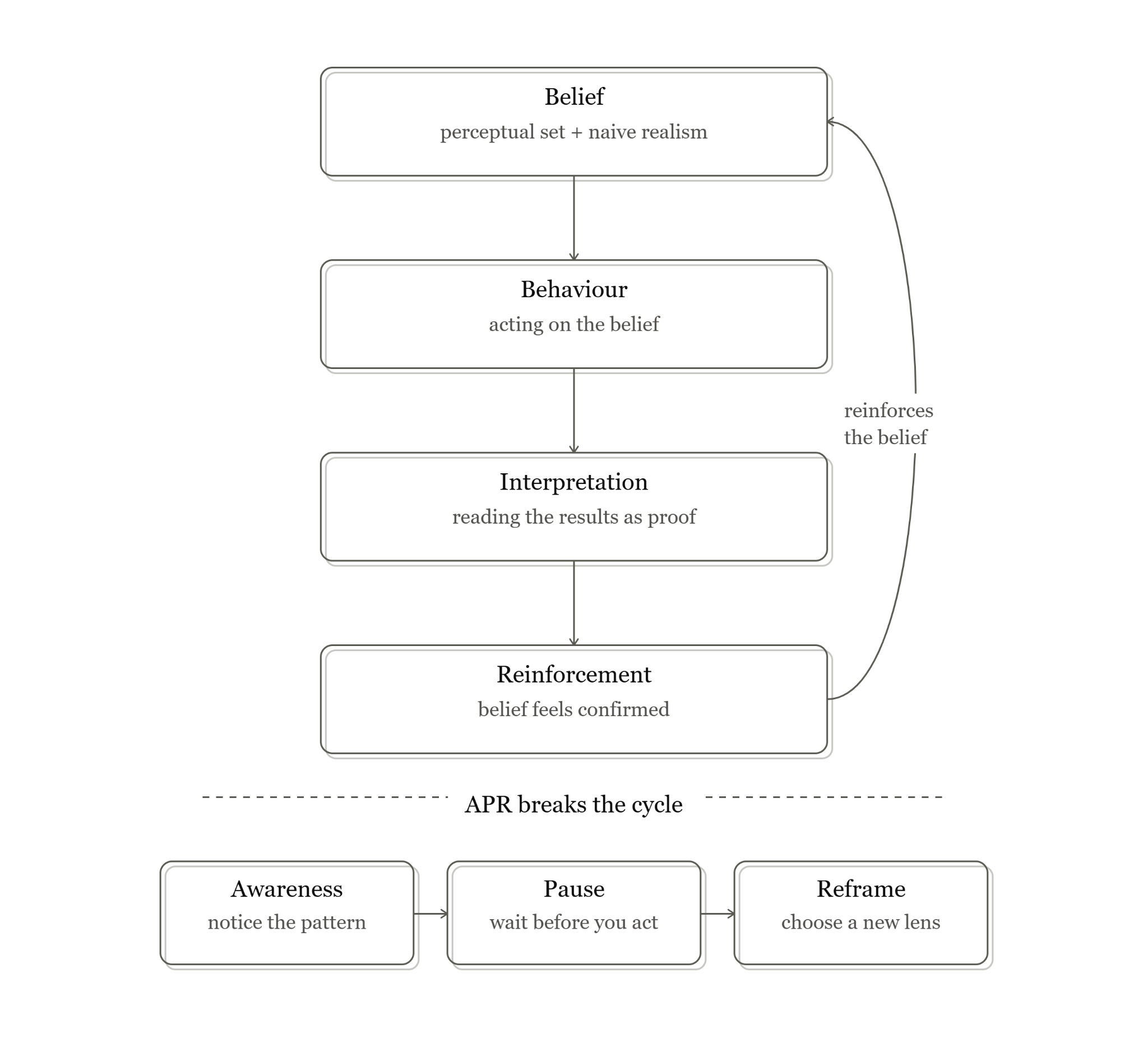
When we interpret a situation in a way that is detrimental to us, we may form a conception that we start to believe in, which in the end guides our decisions and might lead to negative outcomes. We are dealing then with a belief-behaviour feedback loop: belief (based on the perceptual set and naïve realism)→ behaviour → interpretation → reinforcement. Let’s better understand this mechanism through a case study on the self-fulfilling prophecy of acceptance. In an experiment with university students at the University of Waterloo, the participants who expected to be less socially accepted in an interaction with the confederate tended to behave less warmly and were liked less by the independent observers. Interestingly, in a subsequent experiment, when the perceived risk of rejection was reduced, the socially pessimistic participants behaved more warmly and received levels of acceptance similar to those who had expected to be liked from the beginning (Stinson et al., 2009).
So, if our beliefs and expectations can change our interactions and how we experience the world around us, how can we then reconstruct our perception of reality to our advantage? Awareness - Pause - Reframe is a three-step technique that can break the loop. Let’s say our friend who studies at a technical university invites us, a social science major, to a student party. We are anxious about meeting these new people because we think they won’t like us since we don’t have enough things in common. The first step is to become aware of the way we are feeling and of the reasons we are interpreting the situation in this manner. We recognize that “not having something in common” is an assumption, rather than an established fact. The second step, pause, is about creating distance between this initial interpretation and our response. Instead of immediately allowing the assumption to determine our behaviour, we can ask ourselves: ‘What evidence do I have that they will not like me? Do people need to share my academic background to get along with me?’. Finally, we reframe the situation by considering alternative interpretations: ‘Perhaps they are just as interested in meeting someone from a different field; perhaps we can connect over music or hobbies.’ We do not need to convince ourselves that the party will definitely go well; we simply replace an overly certain prediction with a more open interpretation of what might happen. While the shift may seem small, it changes the starting point of the belief-behaviour loop. Instead of entering the party expecting rejection and consequently behaving more cautiously or withdrawn, we approach the situation with greater openness, creating more opportunities for positive interactions.
Understanding how we perceive and construct reality puts us in a very powerful position. It allows us to question the interpretation we are taking for granted and replace an expectation that confines us with one that leaves room for a different outcome. Through becoming aware of what determines our perceptual set and through the APR technique, we can reconsider our own interpretation when it no longer helps us in grasping the bigger picture. After all, what looks unmistakably like a hat to us may still conceal a boa constrictor digesting an elephant.