Four ways of using knowledge in a team: A model for understanding how people learn and act in collective work
What looks like a personality clash may reflect different ways of using knowledge within a team. This article introduces an exploratory four-profile model to help teams understand these differences and discuss when each perspective is needed, without reducing people to fixed personality types.
1. Introduction
For decades, organizational learning research produced increasingly precise answers to an increasingly abstract question. Kolb (1984) described the cycle through which direct experience is transformed into knowledge. Argyris and Schön (1978) distinguished between correcting what fails and questioning why it fails. March (1991) showed that every organization lives in tension between refining what it already masters and seeking what it does not yet know. Nonaka and Takeuchi (1995) explained how individual knowledge becomes the collective's patrimony. Each of these contributions is precise in what it observes, and none answers a more immediate question: within a concrete team, how are the different ways of relating to knowledge distributed among its members?
The question arose from years of direct work with teams in Chile, where the most rigorous training programs were not changing the way people worked. Organizations had invested time and resources, the content was adequate, the facilitators were competent, and yet the training was not being applied in practice. The problem was that each member processed what was learned from a different logic. Some needed everything to be proven before acting; others applied without much reflection; others brought ideas from fields no one had considered; and others halted everything to question whether the problem had been properly framed. When these behaviors generated conflict within the team, the typical interpretation was that the people simply did not get along.
This article names and differentiates those positions. The model organizes four orientations through a two-dimensional structure: the first axis opposes conservation of existing knowledge to its transformation; the second opposes problem orientation to action orientation. That structure produces four quadrants corresponding to the four profiles. The profiles emerged from direct field observation and are grounded in theory that had already described those orientations, though at the organizational level rather than at the team level.
The proposal has two fronts: to offer a theoretically grounded model for researchers studying team learning, and to put in the hands of those who design organizational interventions a collective reflection tool with real practical use. The scope is exploratory: there is a documented inductive process, a theoretical base supporting it, and a validation agenda for those who wish to continue from here.
2. Theoretical Framework
2.1 Learning as a Cycle: Kolb (1984)
Kolb proposed that learning occurs when direct experience passes through four stages: living it, observing it from a distance, abstracting it into a concept, and testing that concept in a new situation. Drawing on Dewey, Lewin, and Piaget, he argued that knowledge is not received but constructed through that cycle. Based on the preferences people show throughout this process, he identified four individual learning styles: divergent, assimilator, convergent, and accommodator, each with a distinct mode of capturing and transforming experience.
What is useful about Kolb for this work is that these preferences are relatively stable and observable. What differentiates his model from the one proposed here is the focus: Kolb describes how a person learns alone. This article asks how that person uses what they know when working with others. The same learning style can give rise to very different behaviors depending on the role a person occupies in a group, the pressures they face, and what others need from them at each moment.
2.2 Correcting or Questioning: Argyris and Schön (1978)
Argyris and Schön distinguished two modes of responding to error in an organization. The first, which they called single-loop learning, occurs when something is detected to have failed and the action is adjusted to correct it, without touching the assumptions governing that action. It is the efficient mode: doing what is already done better. The second, double-loop learning, occurs when correction requires first examining and modifying those assumptions. It is the transformative mode: questioning why things are done as they are before deciding how to do them better.
Both modes are necessary. Without the single loop, every decision would require rebuilding the reasoning from scratch. Without the double loop, teams repeat what they already know how to do even when the context has changed and the familiar response no longer works. The absence of either produces fragile organizations for opposite reasons.
2.3 Refining or Exploring: March (1991)
March proposed that every organization lives in opposition between two orientations toward knowledge. Exploitation consists of using, refining, and extending what is already mastered: it produces predictable short-term results but can become a trap if it is the only mode of operation. Exploration consists of searching, experimenting, and developing what is not yet known: it is more uncertain and costly in the short term, but it is what makes adaptation possible when the environment changes. That tension gave rise to the concept of organizational ambidexterity, the capacity to maintain both orientations simultaneously without one negating the other (Lubatkin et al., 2006).
Gupta, Smith, and Shalley (2006) analyzed the relationship between exploration and exploitation at the firm level and concluded that both orientations can deliberately coexist as a source of strategic value. That finding operates at the organizational level. The hypothesis this article extends to the team level, that people with different orientations can complement each other when their diversity is managed with intention, is an extrapolation that future validation must test empirically.
2.4 From Personal to Shared Knowledge: Nonaka and Takeuchi (1995)
Nonaka and Takeuchi described organizational knowledge as the result of a conversion spiral between two forms of knowing: tacit, embedded in experience and difficult to formalize; and explicit, codifiable and transferable. They identified four conversion modes forming the acronym SECI: Socialization, sharing tacit knowledge through direct experience; Externalization, converting tacit knowledge into explicit concepts; Combination, reconfiguring explicit concepts to produce new knowledge; and Internalization, translating explicit knowledge into incorporated practice as tacit knowledge.
The SECI model describes an organizational cycle of knowledge conversion, not individual positions within a team. The correspondences established in Table 3 of this article between the four profiles and the SECI modes are hypothetical conceptual affinities derived from analogical reasoning, not empirically established equivalences. They are presented as starting points for future research, not as validated characterizations.
2.5 Cognitive Diversity: Resource and Drain
Van der Vegt and Janssen (2003) defined cognitive diversity as systematic differences among team members in their ways of thinking, their knowledge, and their schemas for interpreting situations. Shin, Kim, Lee, and Bian (2012) found that this diversity positively predicts individual creativity within the team, but only in the presence of high transformational leadership and when members possess high creative self-efficacy. Chua, Roth, and Lemoine (2015) identified two independent effects of culture on creativity in global collaboration contexts: cultural distance between collaborators hampers the adoption of creative ideas, and the normative rigidity of the originating cultural context operates as an additional factor that further moderates that adoption negatively. Both effects are statistically distinguishable in their model.
The evidence shows that diversity, whether cognitive or cultural, does not generate value automatically. For differences to translate into innovation rather than blockage, leadership that channels them and environments with the flexibility to process them are required.
2.6 What Theory Does Not Resolve
The frameworks reviewed describe with precision how organizations as a whole learn. Kolb describes individual learning preferences, but not their function within a group. Argyris and Schön describe two modes of error response, but not how people who habitually inhabit one or the other coexist within the same team. March describes the exploitation-exploration tension at the strategic level, but not how that tension is embodied in individuals working together every day. Nonaka and Takeuchi explain how knowledge circulates within an organization, but not the position each person adopts relative to that cycle.
That is the space the four-profile model presented in the following section occupies.
3. Methodology
3.1 An Inductive Approach from the Field
The model did not originate from a hypothesis set out to be verified. It originated from a recurring problem that accumulated in field notes. The method that best describes that process is grounded theory as applied to organizational behavior (Glaser & Strauss, 1967; Martin & Turner, 1986): first one observes, records, and codes patterns, and only then proposes categories. The categories are then subjected to progressive verification as new data accumulate. It is an inverse process to the deductive: theory emerges from observation rather than preceding it.
The scope warrants clarification. Grounded theory in the strict sense requires theoretical saturation, multiple data sources, and formal coding procedures with inter-coder agreement. What is described below is compatible with the principles of that method in its initial phase, but does not complete that cycle. The model is the result of systematic induction from professional practice and requires formal validation, as explained in the limitations section.
3.2 The Process in Three Phases
Phase 1. Observation and recording, 2018–2022.
Over four years, the practitioner-author carried out training and consulting interventions in organizations across four sectors: technology, logistics, manufacturing, and professional services, all in Chile. In total, 14 work teams and 87 individual participants were engaged. Teams had between four and twelve members. In each intervention the author recorded the orientation each participant habitually adopted in relation to the team's knowledge: what type of contribution they made, which situations generated resistance, which type of contribution they systematically avoided or deferred. At the end of each intervention, these records were documented in structured field notes, with date, context description, non-nominal identification of participants, and description of observed patterns.
The interventions were conducted within organizational consulting and training engagements. Participants were informed of the purpose of the work and the fact that observations might be used for research purposes. They expressed consent verbally, as the context was professional practice rather than formal academic research. No institutional ethics committee review was obtained, a limitation explicitly acknowledged. Records were anonymized prior to any analysis: no working document identifies persons, teams, or organizations by their real names. In the illustrative case presented in Section 5, names have been changed.
Phase 2. Coding and categorization, 2022–2023.
The accumulated records were coded following the initial and focused coding process described by Charmaz (2014): descriptive codes were first assigned to observation fragments; these were then grouped into higher-order categories. From this work, four categories emerged with internal coherence and clear differentiation from one another.
During coding, explicit attention was paid to negative cases, that is, observations that did not fit the emerging categories or contradicted them. In several teams, participants were recorded whose behavior oscillated between two orientations depending on the type of task or stage of the project. These observations led to introducing the notion of predominant orientations into the model, rather than fixed types, and to recognizing that the same person may move between quadrants depending on context. Mixed cases were documented as findings, not discarded.
When the emerging categories were compared against the literature, conceptual alignment was found with March's (1991) exploration-exploitation tension and with Argyris and Schön's (1978) learning modes. That convergence strengthened the plausibility of the categories, though it does not validate them psychometrically.
Phase 3. Progressive verification, 2023–2024.
The four categories were used as a reading framework in new intervention contexts. During this period, work was conducted with five additional teams (approximately 35 participants) in the same sectors of origin. In all cases, naming the differences in orientation within the teams produced reframings of conflicts that the participants themselves had attributed to personal incompatibilities. This verification is qualitative in nature: it documents the interpretive utility of the framework under real conditions of use, not its psychometric validity. Data from this phase are not included in the total of 14 teams and 87 participants, which corresponds exclusively to Phases 1 and 2.
3.3 Differences from Existing Frameworks
The four profiles are not intended to replace validated instruments such as Kolb's Learning Style Inventory (LSI). Their difference lies in focus and intended use. Regarding the MBTI, it is worth noting that its organizational use has been subject to sustained methodological debate: the literature has questioned its test-retest reliability, the stability of its typologies, and the validity of its dichotomous assumptions (Boyle, 1995; Pittenger, 1993). The four profiles of this model do not derive from the MBTI, nor do they share its typological assumptions. The comparison with Kolb's LSI remains a hypothesis for future validation, as detailed in the research agenda. Table 1 summarizes the model's differential positioning.
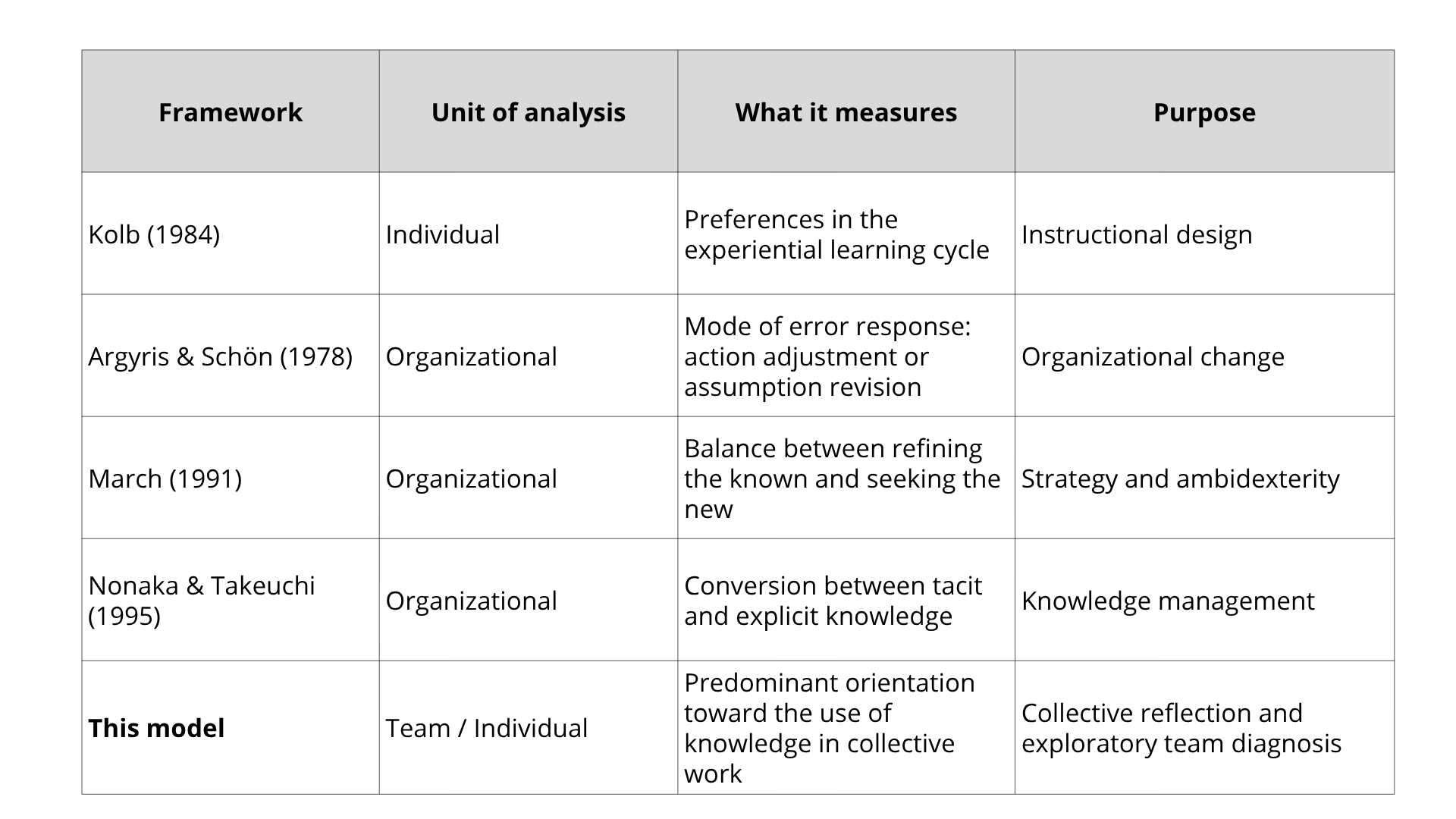
Note. The frameworks listed operate at different levels of analysis. This model is situated at the work team level, a level that prior frameworks do not directly address.
4. The Four-Profile Model
4.1 The Two-Dimensional Structure of the Model
The frameworks reviewed in Section 2 share an underlying problem: what to do with what is already known. The model takes that dilemma and disaggregates it through two axes that organize the four orientations.
The first axis opposes conservation of existing knowledge to its transformation. At the conservation pole are those who tend to preserve and apply proven frameworks, procedures, and solutions, prioritizing consistency and reduction of uncertainty. At the transformation pole are those who tend to question those frameworks or reconfigure them to produce something different, prioritizing renewal over stability. This axis captures March's (1991) exploitation-exploration tension and Argyris and Schön's (1978) distinction between single and double loop.
The second axis opposes problem orientation to action orientation. At the problem-orientation pole are those who, before intervening, prioritize understanding, precise definition of the situation, or questioning the assumptions that frame it. Their typical contribution is cognitive: clarifying what is being solved before acting. At the action-orientation pole are those who prioritize execution, implementation, and the achievement of concrete results. Their typical contribution is operational: moving the team from analysis toward outcome.
The combination of these two axes produces four quadrants, each corresponding to a predominant orientation. The conservation-transformation axis accounts for the relationship with the content of knowledge; the problem-action axis accounts for the way that knowledge is mobilized within the team. The profiles are not fixed types but predominant orientations: a person may move between quadrants depending on context, type of task, and stage of the project.
4.2 The Four Profiles
Each profile is described with four elements: its position on the two axes, its characteristic relationship with the team's knowledge, the contribution it makes when functioning well, and the risk it produces when acting without the counterbalance of the others. None is superior to the others; all are necessary and all have limits when exercised in isolation, just as March showed that neither pure exploitation nor pure exploration is sustainable.
Table 2 The Four Profiles: Position on the Axes, Relationship with Knowledge, Contribution, and Risk
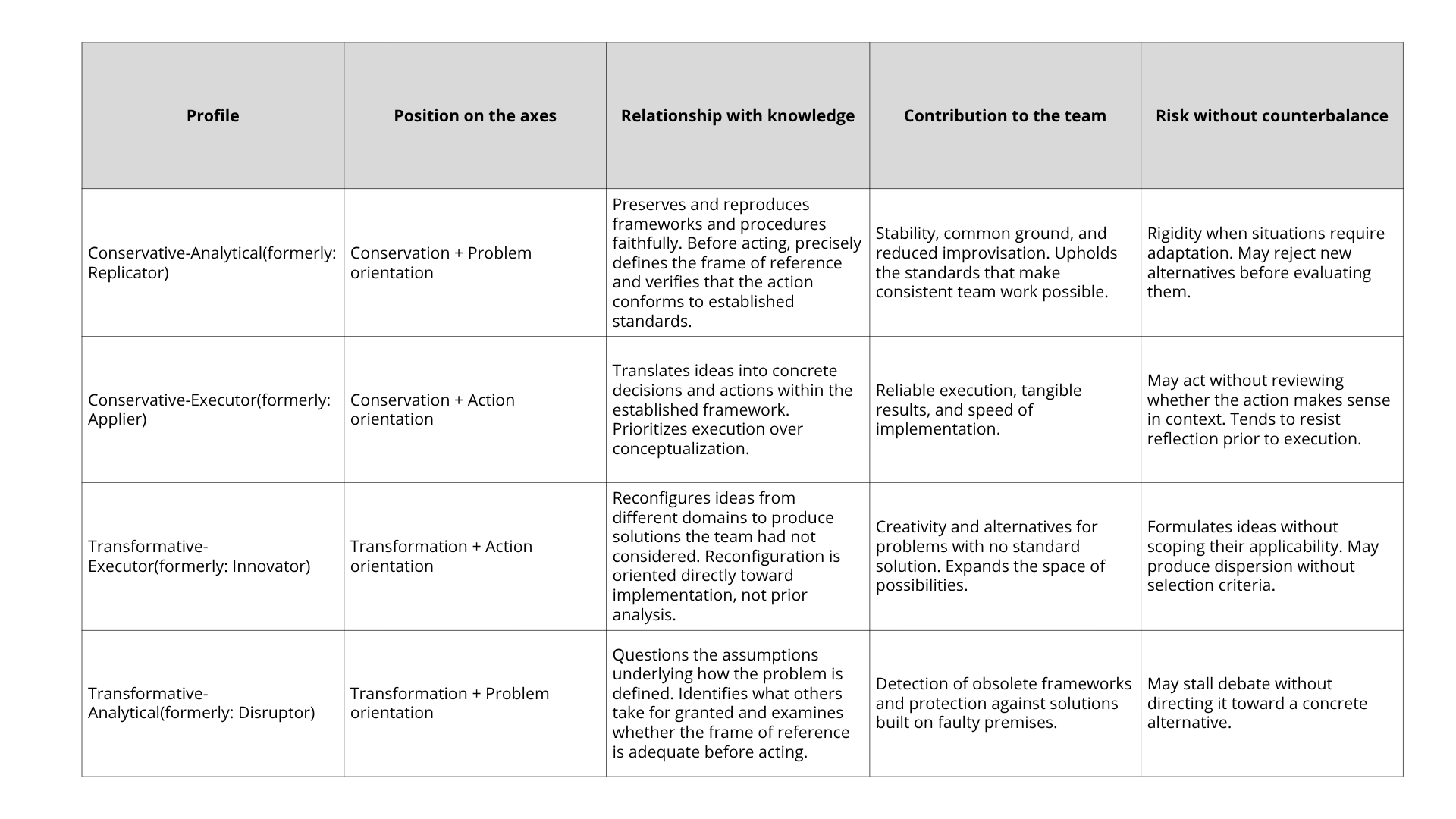
Note. Names in parentheses are the designations used in earlier versions of the model. The new names explicitly reflect each profile's position on the two axes structuring the model. Descriptions correspond to predominant orientations, not fixed personality traits.
4.3 Hypothetical Conceptual Affinities with the Theoretical Frameworks
The profiles were identified inductively and, when compared against the literature, showed conceptual alignment with categories that theory had already formulated at the organizational level. Table 3 synthesizes those affinities.
The epistemological status of this table warrants clarification. The correspondences presented are not direct theoretical equivalences nor empirically validated findings. They are hypothetical conceptual affinities derived from analogical reasoning between frameworks formulated for different levels of analysis. They function as working hypotheses for future research, not as established characterizations. In particular, the correspondences with Nonaka and Takeuchi's SECI modes should be read with additional caution: the SECI model describes an organizational cycle of knowledge conversion, while the profiles describe individual orientations within a team. The assignment of profiles to specific SECI modes is an analytical extension by this article's author that goes beyond what Nonaka and Takeuchi (1995) formulated in their original work. The dual assignment of some profiles within Kolb's framework (for example, Divergent / Accommodator for the Transformative-Executor) reflects that no single Kolb style fully captures that orientation, which is itself an indicator that the two models are not isomorphic.
Table 3 Hypothetical Conceptual Affinities Between the Profiles and the Theoretical Frameworks of Reference
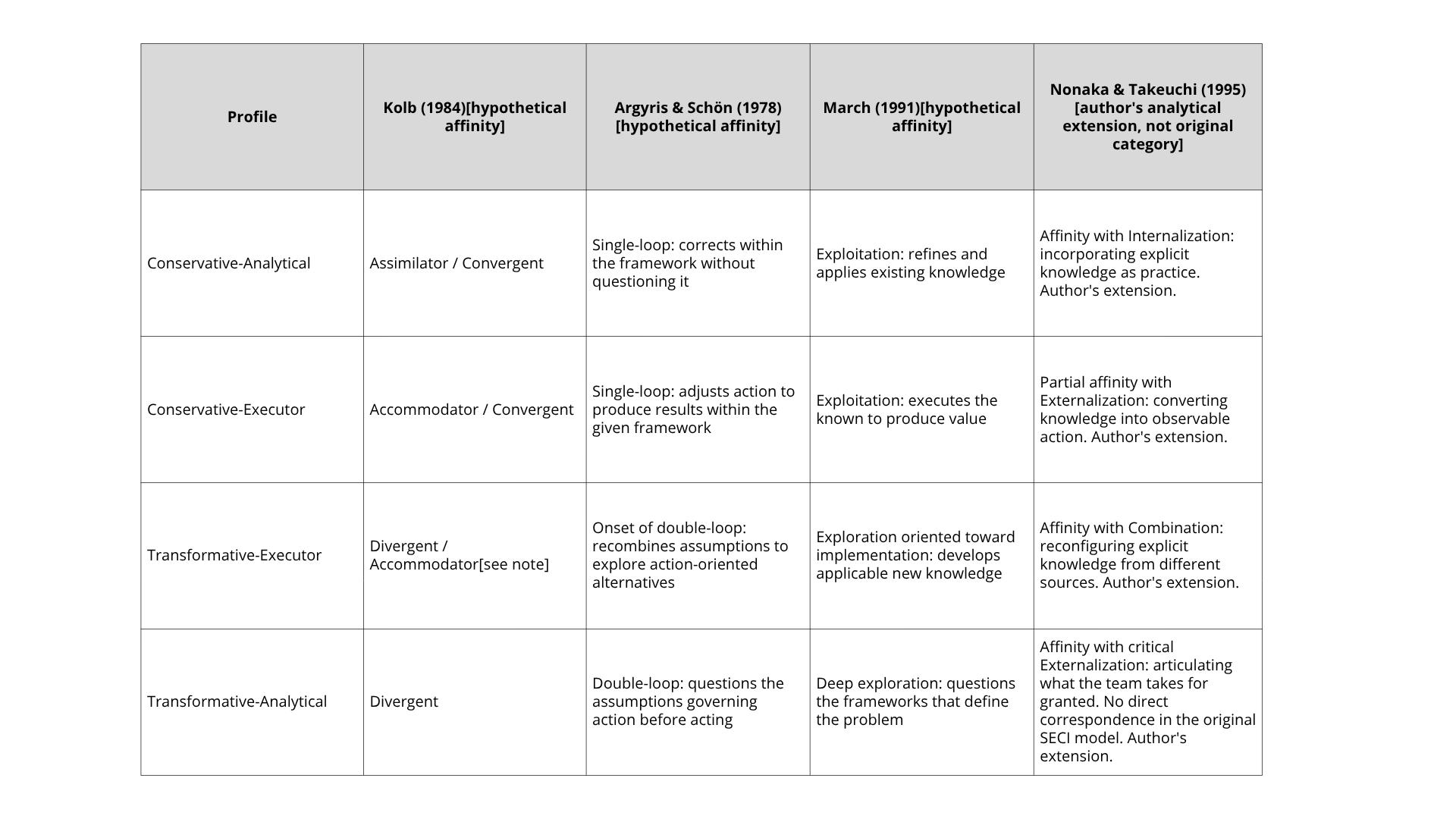
Note. Affinities with Kolb (1984), Argyris and Schön (1978), and March (1991) are hypothetical conceptual correspondences, not empirically validated equivalences. Correspondences with Nonaka and Takeuchi (1995) are the author's analytical extensions; they are not formulated in the original SECI model nor have they been empirically tested. The dual Divergent/Accommodator assignment for the Transformative-Executor in Kolb's framework indicates that no single Kolb style fully covers that orientation: the Divergent combines concrete experience with reflective observation (CE+RO), while the Accommodator combines concrete experience with active experimentation (CE+AE); the action orientation of the Transformative-Executor approximates the Accommodator, but its reconfiguration of ideas approximates the Divergent. All correspondences in this table should be treated as hypotheses for future research.
4.4 Why Diversity of Orientations Requires Active Management
A team with all four orientations represented possesses different capabilities for diverse situations, but that variety does not translate into better performance on its own. Research on cognitive diversity shows that gains in creativity and innovation appear only when there are coordination mechanisms that integrate different perspectives (Shin et al., 2012; Van der Vegt & Janssen, 2003). Without those mechanisms, a Transformative-Analytical perceived as someone who always complicates things and a Conservative-Analytical perceived as someone who always brakes do not complement each other: they confront each other without either yielding or synthesizing.
5. An Illustrative Case: Four Orientations, One Assumption Nobody Had Questioned
In 2023, the author worked for eight weeks with a team of six people developing a document management application for a port logistics company in Chile. The intervention included four two-hour group sessions and individual interviews at the outset. Names have been changed to protect participants' identities. This case is one of those included in Phase 3 of progressive verification and does not form part of the corpus of 14 teams from Phases 1 and 2.
From the first session the problem was clear, and it was not technical. They interrupted each other and changed topics before closing the previous one; some arrived with advanced prototypes built on assumptions others had not agreed upon. One stood out in that disorder: Carlos questioned in every meeting whether the process they were automating made sense in the first place. The other five saw him as someone who was stalling the project.
The questionnaire was administered in the first session as a collective reflection tool, without psychometric pretension. The scores reported below have purely descriptive value within the intervention process: they indicate each participant's self-perceived orientation at that moment, not validated measures of their cognitive characteristics. Rodrigo, the port regulations specialist, scored 23 out of 25 on the Conservative-Analytical profile; Andrea and Felipe, the two lead developers, 21 and 20 on the Conservative-Executor profile; Mónica, the systems designer, 22 on the Transformative-Executor profile; and Carlos and Sofía, 21 and 22 on the Transformative-Analytical profile. Results were presented to the team without prior interpretation, and they were asked to describe how they experienced the meetings. Their responses ran through, almost point by point, the risk column of Table 2.
Rodrigo said they were moving too fast without respecting the regulations. Andrea and Felipe said the conceptual discussions prevented them from writing code. Mónica proposed reorganizing the architecture every two weeks. Carlos and Sofía questioned whether the process they were digitalizing made sense, given that it replicated structural inefficiencies in the port system. Each orientation was named aloud. Rodrigo said: "So I'm not the one who brakes—I'm the one who knows where the legal boundary is." Carlos said: "So I'm not obstructing. I'm asking the question nobody else is asking."
The agreement that followed was concrete: before advancing on any new functionality, Carlos and Sofía had ten minutes to ask the questions they considered critical. If those questions were not answered, the team did not advance. Three weeks later, in one of those sessions, Carlos identified that the document approval workflow assumed that customs agents and port operators used the same container identification system. They did not. Had that discrepancy been discovered after launch, they would have had to rebuild a central component of the system.
5.1 What This Case Does Not Prove
This case has value for understanding the model in a real situation, not for establishing its efficacy. There is no comparison group. The improvement the team perceived was not measured with objective indicators: it is based on participants' accounts and the facilitator's judgment. The changes attributed to the orientations framework might respond to other elements of the intervention, such as the structure of the sessions or the sustained attention the team received. Those limitations are inherent to illustrative cases in applied research.
6. The Collective Reflection Questionnaire
6.1 Purpose and Scope
The instrument presented below was designed as a collective reflection tool for use in team intervention processes. Its purpose is to facilitate conversation about the different ways members relate to the group's knowledge, not to produce individual psychometric measurements or clinical or occupational diagnoses. The distinction is important: the questionnaire has not been subjected to the validation procedures that would be required to use it as an assessment or personnel selection instrument.
The instrument may be useful as a starting point for a team to name and discuss differences that would otherwise be attributed to personal incompatibilities. Its value lies in the conversation it facilitates, not in the scores it produces.
6.2 Design and Structure
The questionnaire has 20 statements, five per profile, describing habitual behaviors in work situations. The scale runs from 1 to 5, anchored at "Does not describe me" and "Describes me completely." Statements are written in the first person and describe observable behaviors. The relationship between each statement and the profile it explores is not visible to the respondent: this design decision follows procedural recommendations for reducing social desirability bias, as not revealing the construct being measured reduces the probability that respondents will adjust their answers to what they perceive as socially desirable (Podsakoff et al., 2003). Statements from different profiles are interleaved so that those from the same profile do not appear consecutively. The assignment of each statement to its corresponding profile is provisional and must be subjected to expert judge evaluation and factor analysis, as specified in the validation agenda (Section 8).
Distribution by profile: Conservative-Analytical (items 1, 5, 9, 13, 17), Conservative-Executor (items 2, 6, 10, 14, 18), Transformative-Executor (items 3, 7, 11, 15, 19), Transformative-Analytical (items 4, 8, 12, 16, 20).
Table 4 Team Learning Orientations Questionnaire (Scale 1 to 5)
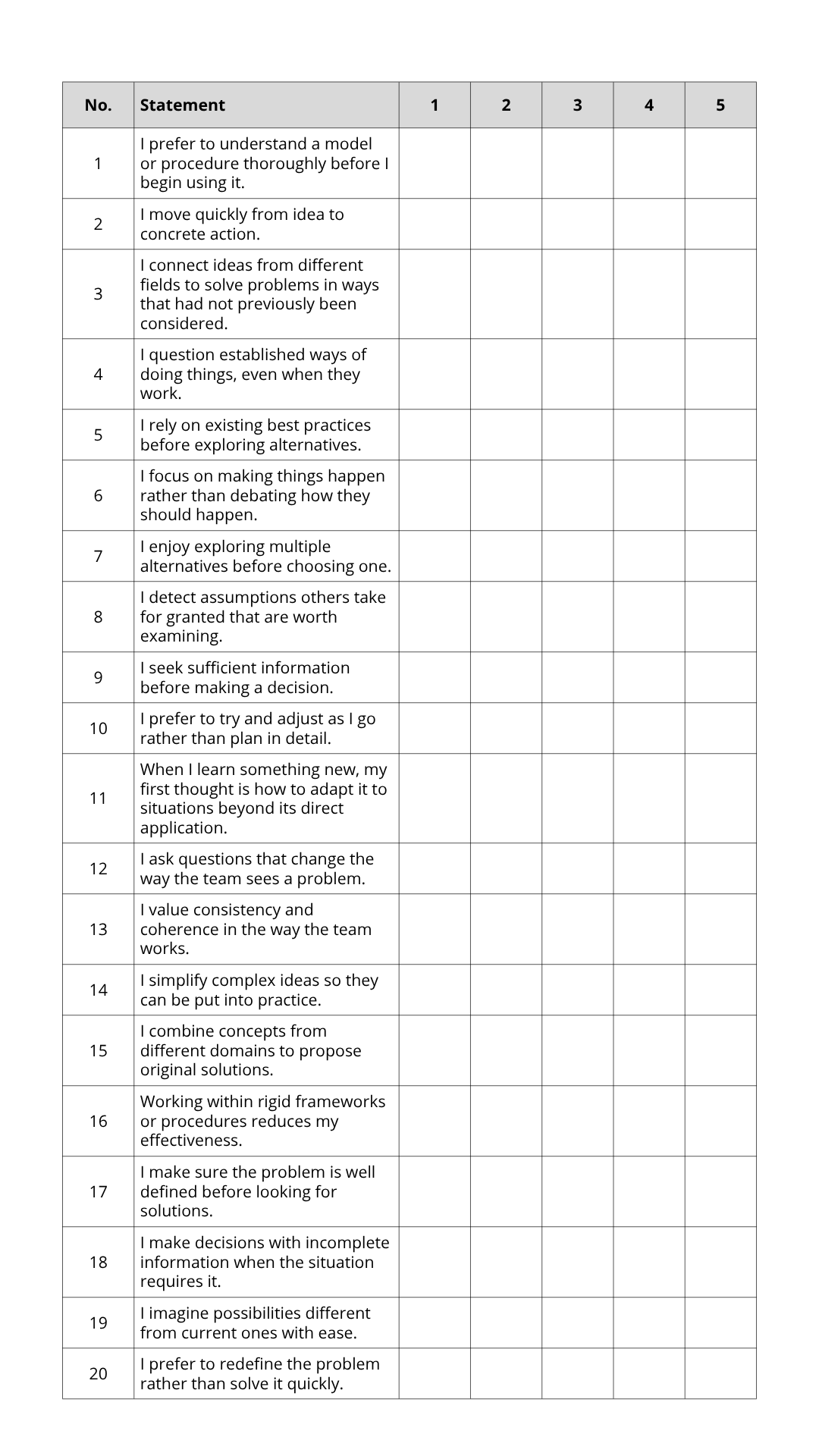
Note. The scale uses the Likert-type response format (Likert, 1932): 1 = Does not describe me; 5 = Describes me completely. Item 11 was reformulated relative to earlier versions to more precisely capture the reconfiguration of what is learned toward non-conventional applications, a characteristic of the Transformative-Executor profile. The assignment of all items to their corresponding profiles is provisional and subject to revision through factor analysis and expert judge evaluation (see Section 7, Limitation 2, and Section 8). This questionnaire is an exploratory collective reflection tool. It has not been subjected to formal psychometric validation and must not be used as an individual assessment instrument, for personnel selection, or for organizational diagnosis.
6.3 Guidelines for Reflective Use of the Instrument
Questionnaire results are calculated by summing the scores for the five items of each profile. The maximum score per profile is 25 and the minimum is 5. These values allow identification of which orientation predominates in each person's self-perception at that moment, but do not establish diagnostic categories or normatively supported interpretation thresholds. The distribution of scores within the team can serve as a starting point for discussion, not as a definitive classification.
Given that the instrument lacks normative data and psychometric validation, its use is recommended exclusively in facilitated contexts, where a professional can guide interpretation and prevent orientations from becoming labels. Table 5 suggests, on an indicative basis, some reflection points associated with each orientation.
Table 5 Suggested Reflection Points by Predominant Orientation
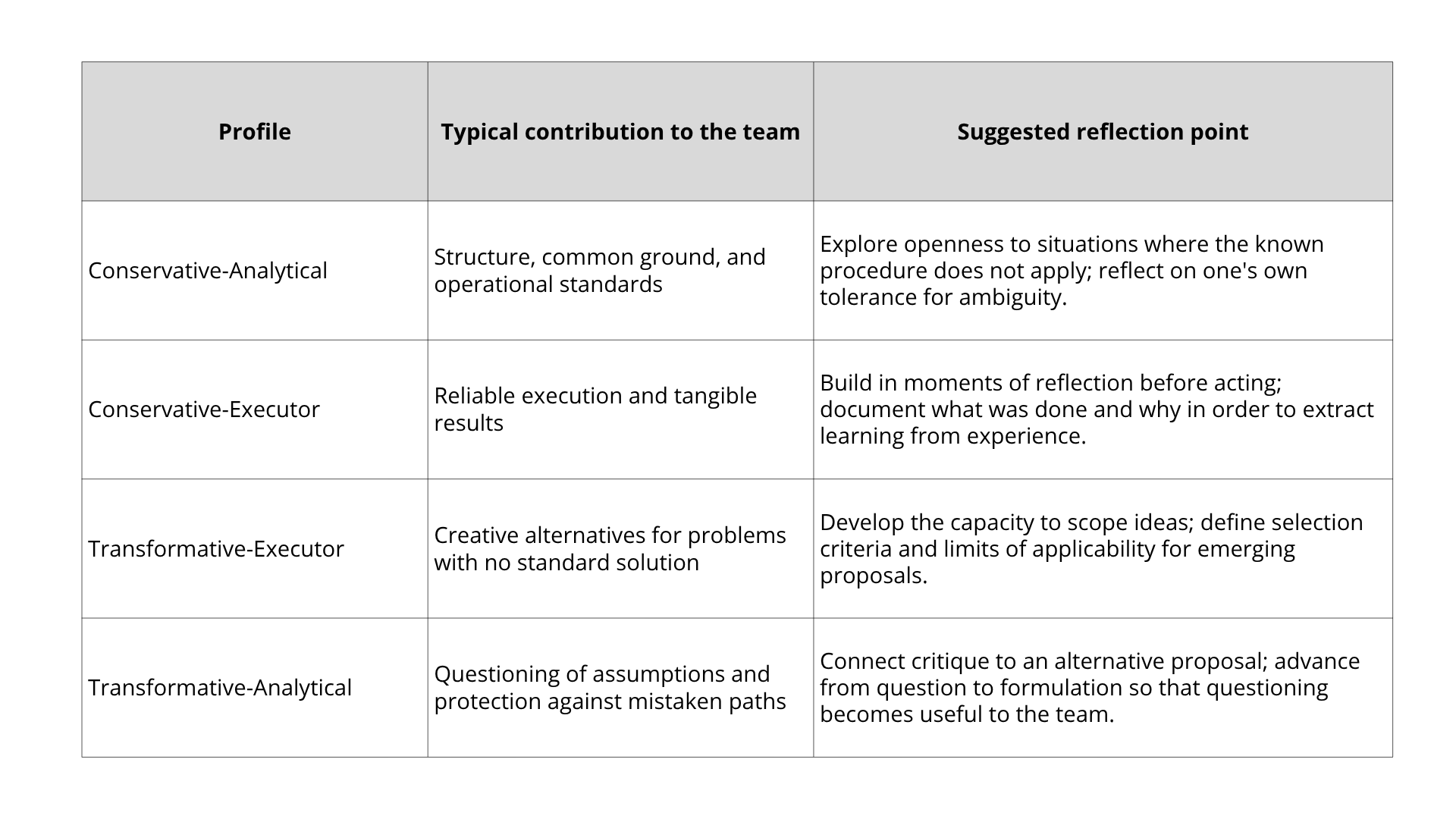
Note. Reflection points are indicative suggestions derived from field observation, not evidence-based prescriptions from controlled empirical research. They should be treated as starting points for conversation and not as validated individual development recommendations.
7. Limitations of the Model and the Instrument
The questionnaire was developed from professional practice and has theoretical grounding, but has not undergone the formal psychometric validation procedures required to use it in quantitative research. That delimitation tells other researchers where the missing empirical work lies.
Limitation 1. Single observer.
The model emerged from the observation of a single practitioner-researcher across 14 teams and 87 participants in Chile between 2018 and 2022. It is consistent with the initial phases of grounded theory, but introduces risk of confirmation bias and overgeneralization. Subsequent studies must include multiple observers with inter-rater agreement calculation (Cohen's kappa).
Limitation 2. Content validity not established.
The questionnaire statements have not been evaluated by an independent panel of experts. It is recommended to calculate the Content Validity Index (CVI) per item and for the instrument as a whole, with the minimum threshold of 0.80 proposed by Lynn (1986). This evaluation will also allow verification of the provisional assignment of each item to its profile.
Limitation 3. Reliability not calculated.
No Cronbach's alpha coefficient or other internal consistency measures are available. The reference threshold is alpha ≥ 0.70 (Nunnally, 1978).
Limitation 4. Construct validity pending.
Exploratory factor analysis with oblique rotation is recommended on a minimum sample of 200 respondents, followed by confirmatory factor analysis on an independent sample (Lloret-Segura et al., 2014). The factor analysis will determine whether the four-factor solution —and the two-dimensional structure attributed to the model— holds in empirical data.
Limitation 5. Theoretical affinities without convergent validation.
The correspondences in Table 3 are hypothetical conceptual affinities, not empirically established equivalences. The convergent validity of the model with respect to Kolb's instruments and other cited frameworks is a hypothesis that future validation must explore, not a finding of the present work.
Limitation 6. Absence of ethics committee review.
Field observations were conducted within professional engagements, not formal academic research, and therefore no institutional ethics committee review was obtained. Consent was verbal and anonymization was carried out as professional confidentiality practice. Research continuing this work must obtain formal ethical approval before collecting data for publication purposes.
Limitation 7. Bounded context.
Field observations were conducted in Chile, in the technology, logistics, manufacturing, and professional services sectors. The model's applicability to other cultural, sectoral, or geographic contexts requires independent empirical verification.
Limitation 8. The case is not evidence of efficacy.
The case in Section 5 has illustrative value, not probative value. It does not allow causal inferences, lacks a comparison group, and has no objective pre- and post-intervention measurement.
8. Validation Agenda
In order of priority: (a) content validation by a panel of 5 to 7 experts with CVI calculation, including evaluation of the provisional item-to-profile assignment; (b) pilot study with 80 to 120 participants for reliability analysis and statement refinement; (c) exploratory factor analysis on a sample of 200 or more respondents to verify the model's hypothetical two-dimensional structure; (d) confirmatory factor analysis on an independent sample; (e) convergent validity through correlation with Kolb's LSI and related instruments; (f) predictive validity through longitudinal follow-up of teams with different orientation distributions, with measurement of objective performance indicators; (g) replication in samples from different cultural and sectoral contexts to evaluate the generalizability of the model.
9. Discussion
9.1 What This Model Contributes
March and Argyris and Schön offer powerful frameworks for analyzing how organizations as a whole learn, but neither helps identify how those dilemmas are embodied in concrete people who work together every day. The four-orientation model moves that question to where the work actually happens. By identifying the habitual orientation each member occupies relative to collective knowledge, the framework gives those who lead or facilitate a more precise reading of why the team functions as it does.
The practical contribution is equally specific. When a team has coordination problems, the most frequent interpretation is that there is a personality or communication issue, and that reading leads to relational interventions that rarely touch the underlying cause. When differences among members are read as distinct orientations toward knowledge, the question shifts: no longer who is right, but when the team needs each perspective.
9.2 Direct Objections
Why four profiles and not three or five?
The four categories emerged from the inductive process and found coherence in the two axes that structure the model: conservation versus transformation of knowledge, and problem orientation versus action orientation. That two-dimensional structure naturally produces four quadrants. Whether the number is correct will be determined by factor analysis when verifying whether the four-factor solution best fits the actual data.
Are the profiles just Kolb's styles with a different name?
There is partial conceptual alignment, described in Table 3, but the profiles are not a translation of Kolb's styles. Kolb describes how the individual learns in a cognitive cycle. This model describes how that individual uses knowledge within a collective system. The dual assignment of some profiles in Kolb's framework, noted in Table 3's footnote, is additional evidence that the two models are not isomorphic. The empirical correlation between the two constructs is a hypothesis that future validation must explore.
Does the model not risk labeling people?
Yes, and it is a real risk that must be taken seriously. The profiles are predominant orientations, not fixed traits. An orientation changes with context and with conscious learning. The questionnaire must always be used in a facilitated dialogue context that prevents the profile from becoming a label that defines the person.
9.3 What Remains to Be Investigated
Are the orientations stable over time or do they change with the type of task and context? Are there orientation distributions more effective for certain types of challenges, such as radical innovation, repetitive process execution, or crisis management? How do the orientations relate to variables such as organizational culture, leadership style, or the developmental stage of the team? Is there significant correlation with Kolb's styles, the MBTI, or the Big Five? These questions require longitudinal studies and quantitative designs with large samples.
10. Conclusion
This work began with a practical problem: well-trained teams, with resources and competent facilitators, that kept functioning the same way after each intervention. Tracing the reason, what emerged was a difference in the way each person relates to what they know when they must act alongside others. That difference occurred at the work team level and lacked a name at that level.
The four profiles presented here, Conservative-Analytical, Conservative-Executor, Transformative-Executor, and Transformative-Analytical, are one way to name it. They emerged from direct observation of 14 teams and 87 participants in Chile between 2018 and 2022, and found conceptual support in theories that had already described those orientations at the organizational level: Kolb (1984), Argyris and Schön (1978), March (1991), and Nonaka and Takeuchi (1995). The model brings those categories to the level where differences are experienced daily, and organizes them in a two-dimensional structure whose axes, conservation versus transformation of knowledge, and problem orientation versus action orientation, are empirically verifiable through factor analysis.
The instrument accompanying the model is an exploratory collective reflection tool, not a psychometric diagnostic instrument. Its limitations are detailed in Section 7. The validation agenda proposed in Section 8 traces the steps for other researchers to build on this work. What exists at this point is a documented inductive process, a theoretical base supporting it, and qualitative evidence of its utility under real conditions.