From Manager to Detective: Why Recurring Errors Point to Design Problems, Not People Problems
The employee made the error. The system made that error predictable. When the same mistake appears across competent people, locations, and time, the decision environment deserves investigation.
Why Good Employees Keep Making Predictable Mistakes
Most managers reach for the same explanation when errors keep happening: the people.
Someone was not careful enough. Training did not stick. Accountability was missing. Motivation was low. The organization responds with another training session, tighter oversight, clearer policies, or a performance conversation. The fixes may help for a few weeks. Then the same mistakes return, often in slightly different forms (Reason, 2000).
This pattern is common enough to feel inevitable. It is not.
A Familiar Operational Failure
Consider an illustrative accounts-payable process that is a composite of patterns common in multi-site operations. Employees across several locations are expected to submit complete invoices before month-end close. The policy is documented, the deadline is known, and training has been provided. Yet invoices still arrive late or without the information needed for approval.
The obvious answer is that employees are maybe a little careless when it comes to completing the invoices. This conclusion changes when we look more closely at the decision environment thorough a cognitive lens. The deadline feels distant until it suddenly becomes urgent. Required information is scattered across emails, purchase orders, and vendor records. The submission form does not reveal missing fields until the invoice reaches Accounts Payable. The employee receives feedback days later, after the miss has faded from memory. Meanwhile, submitting an incomplete invoice, or one that feels “complete enough”, is easier than stopping to search for information that may be difficult to find.
The employee made the error. The system made that error predictable.
When the same mistake appears across competent people, locations, and time, the problem is unlikely to be explained by individual effort alone. It is a signal that the decision environment deserves investigation (Reason, 2000).
What Behavioral Science Revealed
Traditional economic models frequently represented decision-makers as choosing the option that maximized expected value according to stable preferences. Herbert Simon challenged the descriptive realism of that assumption by showing that people make decisions under constraints of information, time, and cognitive capacity, outlining a condition that became known as bounded rationality (Simon, 1955). Behavioral research subsequently demonstrated that judgment is systematically shaped by context.
In 1979, Daniel Kahneman and Amos Tversky published Prospect Theory, a descriptive account of how people evaluate gains and losses relative to reference points, weigh losses more heavily than equivalent gains, and respond to framing (Kahneman & Tversky, 1979). Those valuation patterns are not a complete account of workplace error, but they offer a useful lens on why a small immediate cost can feel more salient than a larger cost that is distant, diffuse, or easy to defer, and why change can feel riskier than staying put (Kahneman, Knetsch, & Thaler, 1991).
Because some systems ask employees to remember information under pressure, hunt across scattered sources, interpret unclear options, or push through unnecessary friction, those demands clash with limited processing capacity (Simon, 1955). Research on cognitive load suggests that when a task is made needlessly complex, less capacity remains for the work that matters. The literature was developed mainly in learning settings, the capacity constraint is the relevant parallel here (Sweller, 1988).
A further implication follows from the tendency to conserve cognitive effort. Fiske and Taylor (1984) described people as “cognitive misers”: limited in capacity, they take shortcuts whenever they can. In an operational setting, that means the easy path often wins, not because employees are careless, but because the environment rewards the lower-effort move. Related work on status quo bias shows a reliable pull toward the current or pre-set option (Samuelson & Zeckhauser, 1988). The size of these effects is not fixed: it varies with context, stakes, and how options are presented, so the findings are design inputs rather than universal constants.
The result of these is that defaults and the path of least resistance are among the strongest levers in choice architecture (Johnson & Goldstein, 2003; Thaler & Sunstein, 2008). And when feedback finally arrives days later, stripped of context, it is weakly positioned to change the next submission, especially if it directs attention to the person rather than to the task and the corrective action (Kluger & DeNisi, 1996). In the invoice illustration, the easy path is "submit now" and "fix later". Under those conditions, even capable people produce recurring errors. The people involved are usually trying to do good work. The environment is working against them. More training may improve knowledge, but it cannot compensate indefinitely for a process that repeatedly cues the wrong action or obscures the right one.
Accountability Still Matters
A design perspective does not excuse negligence, misconduct, or deliberate disregard. Individual accountability remains necessary when a person knowingly violates a clear and workable process.
But recurring operational failures require a second level of analysis. When ordinary, well-intentioned employees repeatedly make the same mistake, leaders should examine the system alongside the individual. If the error persists after retraining, appears at the same decision point, or changes when the context changes, the environment is probably contributing to the outcome (Reason, 2000).
The Detective Mindset
I first learned to look beyond individual blame from my father. He spent years as a Chicago Police homicide detective before founding a security firm. He understood that identifying who acted was only part of an investigation. To explain why an outcome occurred, he also reconstructed the conditions, pressures, information gaps, and sequence of decisions that made it possible.
That stance is the Detective Mindset. In organizations, it replaces "Who made the mistake?" with "What in the system made this mistake likely?" Operationally, the Detective does four things:
- Map the decision point. Review the expected behavior against the error. Name the exact moment the error becomes possible (for example, a missed entry on the invoice), not the process in general.
- Trace the information path. Determine what a successful employee must know, where each datum lives, and how many steps separate those inputs from the form.
- Log the cues and friction. Note the environmental cues: defaults, missing validation, delayed feedback, jargon, and handoffs. Anything that makes the wrong action easier than the right one is evidence (Reason, 2000; Thaler & Sunstein, 2008).
- Test for pattern, not personality. Ask whether the same error appears across people, sites, and time, and whether it returns after training. Pattern is a system signal (Reason, 2000).
The Architect Mindset
Diagnosis alone is not enough. The Architect Mindset asks: "How do we change the decision environment so the desired behavior becomes easier, clearer, or more natural?" That is choice architecture (Thaler & Sunstein, 2008), paired with a systems approach to error management (Reason, 2000).
Operationally, the Architect works the same decision point the Detective mapped:
- Expect error. Add forced pauses or required fields so incomplete submissions cannot silently proceed (Thaler & Sunstein, 2008).
- Give task-focused feedback. Surface missing information at the moment of action, with specific corrective guidance - not a delayed note that implies carelessness (Kluger & DeNisi, 1996; Thaler & Sunstein, 2008).
- Reduce extraneous load. Bring required data into the form through lookups, attachments, or pre-fill so the employee is not searching under pressure (Sweller, 1988).
- Reset the default path. Make complete-and-validated the easy path and submit-incomplete the effortful exception (Johnson & Goldstein, 2003; Samuelson & Zeckhauser, 1988).
In the invoice illustration, that can mean prompts at the moment of action, a hard stop when required fields are missing, in-form vendor or purchase-order lookups, and immediate messages that state what to correct - directing attention to the task, not to the employee's identity (Kluger & DeNisi, 1996).
This does not remove human judgment. It shapes the forms, workflows, and feedback loops where judgment occurs so predictable features of cognition work for the firm rather than against it.
A Mini Diagnostic: Observe, Change, Measure
Before scheduling another training session, run a short diagnostic on one recurring error. Use the Detective column to decide whether you are looking at a system pattern, the Architect column to choose a design move, and the Measure column to know whether the change worked.
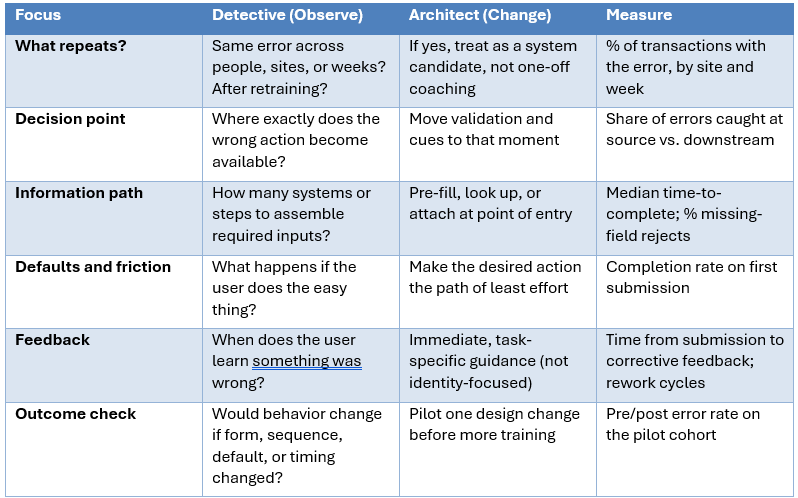
A "yes" to several Detective questions does not prove that the employee bears no responsibility. It indicates that the system is helping produce the result - and that redesign may outperform another reminder.
From Blame to Design
Recurring errors are expensive in operational cost, but they are costly in another way as well. They create a cycle of frustration. Managers feel that employees are not listening. Employees feel that expectations are difficult to satisfy. Oversight increases, trust declines, and the underlying conditions remain unchanged.
Moving from blame to design breaks that cycle. The Manager recognizes the performance problem. The Detective investigates the conditions that made it likely. The Architect redesigns those conditions so the desired behavior becomes the path of least resistance.
The next article in this series will introduce a practical Decision Diagnostic for examining a broken process and deciding whether the environment should support fast, automatic thinking or deliberately interrupt it. Later articles will apply six tools of choice architecture: Defaults, Feedback, Mapping, Designing for Error, Incentives, and Structuring Complex Choices (Thaler & Sunstein, 2008).
The first step, however, is simpler. When something goes wrong, do not ask only, “Who made the mistake?” Ask, “What made this mistake so easy to make?”