Digital Maturity and AI as a Foundation for Designing Organizational Learning
Many organizations define tools, assign uses, and implement AI with a clear objective: improving efficiency or supporting decisions. Months later, several of those initiatives show cracks nobody anticipated: resistance, partial use, dependence on specific profiles, and results that don't scale.
Digital Maturity and AI as a Foundation for Designing Organizational Learning
Many organizations define tools, assign uses, and implement AI with a clear objective: improving efficiency or supporting decisions. Several of those initiatives end up with internal resistance, partial use, dependence on specific profiles, and an investment that does not deliver what was expected.
Every organization starts from a different situation. Gaps in data, talent, or governance that go unexamined at the outset shape everything that follows. Without that prior diagnosis, any tool arrives where there is nothing ready to receive it.
I worked with a Foundation that wanted to incorporate AI to manage its entire volunteer cycle: recruitment, selection, training, and follow-up. Budget was there, so was the executive team's commitment. Excel spreadsheets were the only record, each coordinator managed them differently, and the LMS with the onboarding course was the closest thing to a formal system, though few completed it. Every new situation was handled based on whoever was available that day.
An AI system on that foundation would have operated on scattered data, unwritten procedures, and a team with no clear reference for how the work was supposed to function.
Before evaluating any platform, there was a more pressing question:
What conditions did the organization actually have to receive what it wanted to implement?
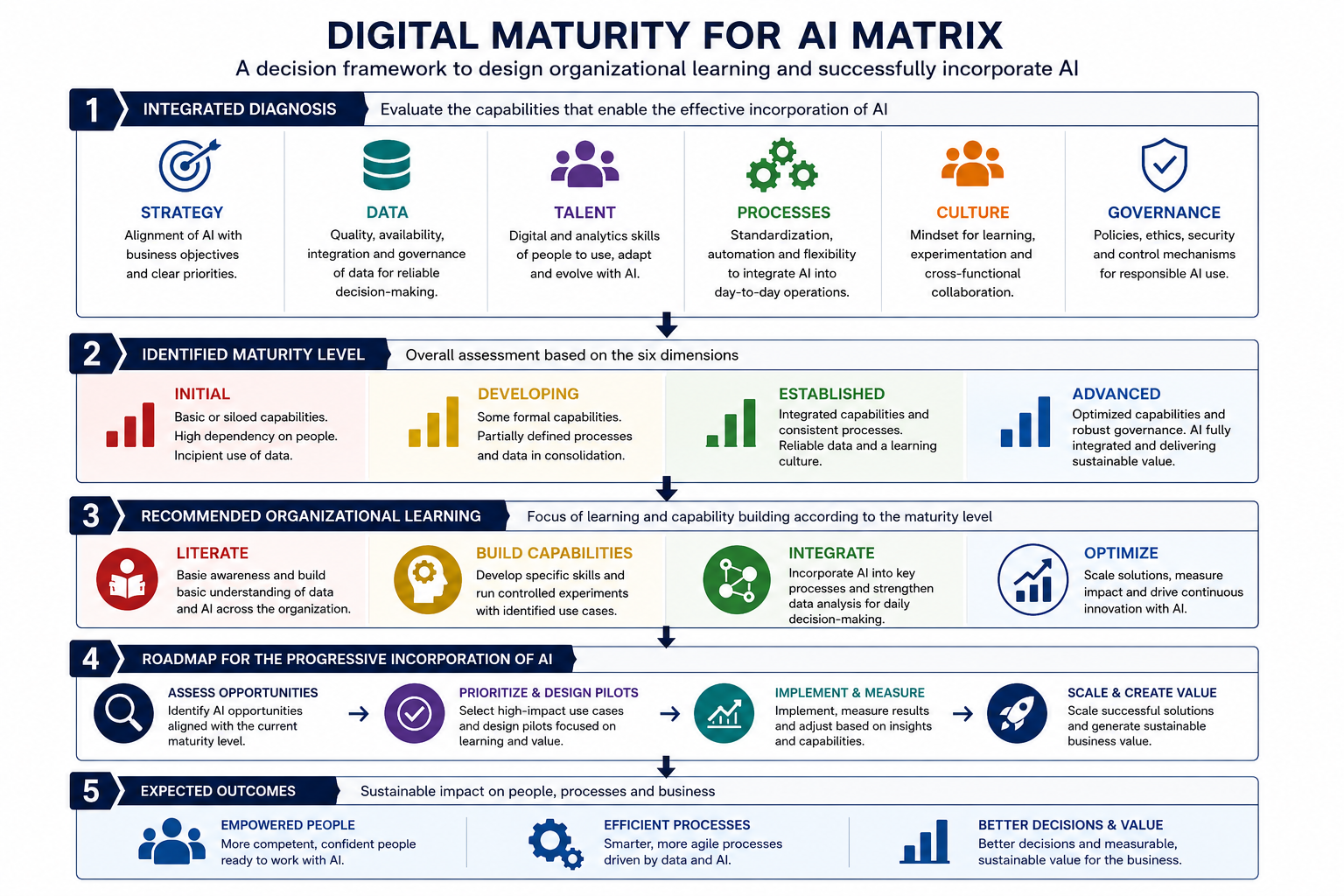
The Digital Maturity Matrix for AI
The Digital Maturity Matrix for AI is a proprietary diagnostic tool. Westerman, Bonnet, and McAfee (2014) documented that digital transformation requires the balanced development of capabilities across multiple dimensions. Kane (2017) specifies that digital maturity presupposes internal conditions that cannot be resolved by purchasing a platform. The matrix starts from that premise and translates it into a diagnosis that guides decisions before the organization takes any technological step.
Models from McKinsey, Deloitte, or BCG measure business performance and degree of technology adoption. This matrix has a different focus: it identifies which capabilities need to be developed before scaling toward more complex initiatives, and in what order, so that each step builds on the previous one.
The matrix evaluates five dimensions: strategy and leadership, data and infrastructure, talent and culture, processes and automation, and governance and ethics. Each is analyzed across four levels with concrete descriptors, based on evidence rather than perceptions. The diagnosis requires profiles from different areas to capture the full reality of the system. The result shows which dimensions are ready to scale and which require prior work.
How Each Dimension Is Evaluated
Strategy and leadership reviews whether AI use has clear objectives or depends on isolated initiatives without shared direction. At the most basic level there is no formal strategy and tools are used on an ad hoc basis. At the most developed, AI is part of the business model and leadership drives it with long-term vision.
Data and infrastructure examines the quality, consistency, and integration of available information. Incomplete records or different criteria across areas directly affect what any system can produce. At the most basic level information is scattered and lacks unified architecture. At the most developed there is data governance and real-time integration.
Talent and culture examines how prepared people are to work with AI and how willing the organization is to modify its practices. At the most basic level resistance predominates and digital skills are low. At the most developed there is a data-oriented culture, with defined roles and teams aligned to the organization's purpose.
Processes and automation observes how defined and standardized the work is. Without that foundation, any technology operates on procedures that vary depending on who executes them and results become unpredictable. At the most basic level processes are manual and poorly structured. At the most developed they are connected across areas and data-driven.
Governance and ethics examines how information is managed, who decides on AI use, and under what criteria. At the most basic level there are no policies or awareness of risks. At the most developed there is algorithmic governance, traceability, and alignment with regulatory frameworks such as the AI Act.
From Diagnosis to Learning Design
When the matrix was applied at the Foundation, four of the five dimensions fell at the initial level: unstandardized processes, data scattered across spreadsheets without shared criteria, basic digital competencies, and no governance policies. Only strategy showed a developing level, because the executive team knew what it wanted, though it had not reviewed what needed to be resolved first.
The roadmap was concrete: document and standardize volunteer processes, define roles, centralize information, and develop digital competencies in the team before evaluating any platform. Becerra et al. (2023) document that organizations with the greatest difficulties in technology adoption are those that move forward before having the capabilities the technology requires.
Learning by Maturity Level
What works in an organization with mature processes and integrated data cannot be transferred to one where coordination depends on informal agreements and spreadsheets are the only record. Each starting point demands a different type of intervention.
- Initial level: the focus is on understanding what digital means and reducing resistance. Literacy, awareness, and building a common language.
- Developing level: practical use of tools. Applied training, guided pilots, and first concrete cases.
- Stable level: learning enters the processes. Analytical capabilities, data use, and informed decisions.
- Advanced level: experimentation, predictive models, and continuous learning.
Asking someone to use AI before understanding what changes in their work produces rejection or use that goes no further than the surface. Direct experience with the tools, testing and applying them in real situations, consolidates what no theoretical explanation achieves on its own. At more mature stages, reading data and deciding based on it becomes part of daily work. At the most advanced levels, the focus is on reviewing past decisions and adjusting based on what accumulated practice reveals.
Avoiding the Premature Jump
Incorporating AI without prior capabilities leaves installed tools that the team does not know how to use. In several cases, already available technologies are underused, and working on that yields more than adding complexity before the right time.
Knowing where the organization stands before setting the pace of progress prevents premature implementations. Nova Arévalo (2023) documents that digital maturity requires developing capabilities across multiple dimensions in a coordinated way, something that happens in stages and not all at once.
Integration with Organizational Learning
When the maturity diagnosis guides learning design, decisions change in scale. The focus shifts from training for a specific tool toward developing skills that can support any subsequent technological change.
Developing people, adjusting processes, clarifying decision criteria, strengthening data use, and accompanying cultural shifts are fronts that advance together. Defining priorities and establishing sequences is what makes each intervention relevant at the moment it occurs.
Identifying the Maturity Level
Having advanced technology and using it with judgment are two different things. An organization can have modern infrastructure and continue making decisions the same way as before, coordinating the same way and working the same way. What digital maturity measures is the degree to which technology effectively changes how decisions are made and how work gets done.
Reviewing how information flows, who makes decisions, and what role learning plays in daily work provides a precise picture of the starting point. With that picture clear, it becomes possible to define what to develop first and what type of intervention makes sense at that moment for that organization.
The decision to incorporate AI is becoming easier to make. What remains difficult is knowing where you are starting from and what needs to be resolved before taking that step. Organizations that stop to answer those questions arrive at implementation with a real foundation. Those that do not find out along the way.